
Pennisetum pedicellatum known as desho grass, fountain grass, kyasuwa grass or Nigeria grass, bare in Mauritania, and deenanath grass in India. It is an indigenous grass of Ethiopia, ideal for livestock feed and can be sustainably cultivated on small plots of land. It used for treatment of wounds, pain related condition, eye and parasitic infections among the traditional healers there. Thus desho is becoming increasingly utilized, along with various soil and water conservation techniques, as a local method of improving grazing land management and combating a growing productivity problem of the local region. This grass is also marked it’s presence in our pristine Nallamala forests, Gundla Brahmesawarm Wildlife Sanctuary. The inflorescence is a pink to purple, dense flowered, cylindrical panicle.




List of Grass species found in Nallamala forests, Eastern Ghats, India
| Sr. No. | Name | Remarks |
| 1. | Acrachne racemosa | It is a small grass with long leaves and inflorescence consisting of alternate branches bearing multifloret spikelets having awn like pointed tips; found at GBM on roadsides. |
| 2. | Apluda mutica | A tall grass with leaf bases narrowed like a petiole and inflorescence bearing several spathes containing spikelets, common all over. |
| 3. | Aristida setacea | A grass with stiff linear inflorescence with florets having three pronged awns, found on roadsides on drier slopes and rocky patches |
| 4. | Arthraxon lancifolius | A dwarf delicate grass found growing on causeways and culverts near stream banks around GBM |
| 5. | Arundinella pumila | A dwarf grass with showy panicles found on causeways and culverts near stream banks around GBM |
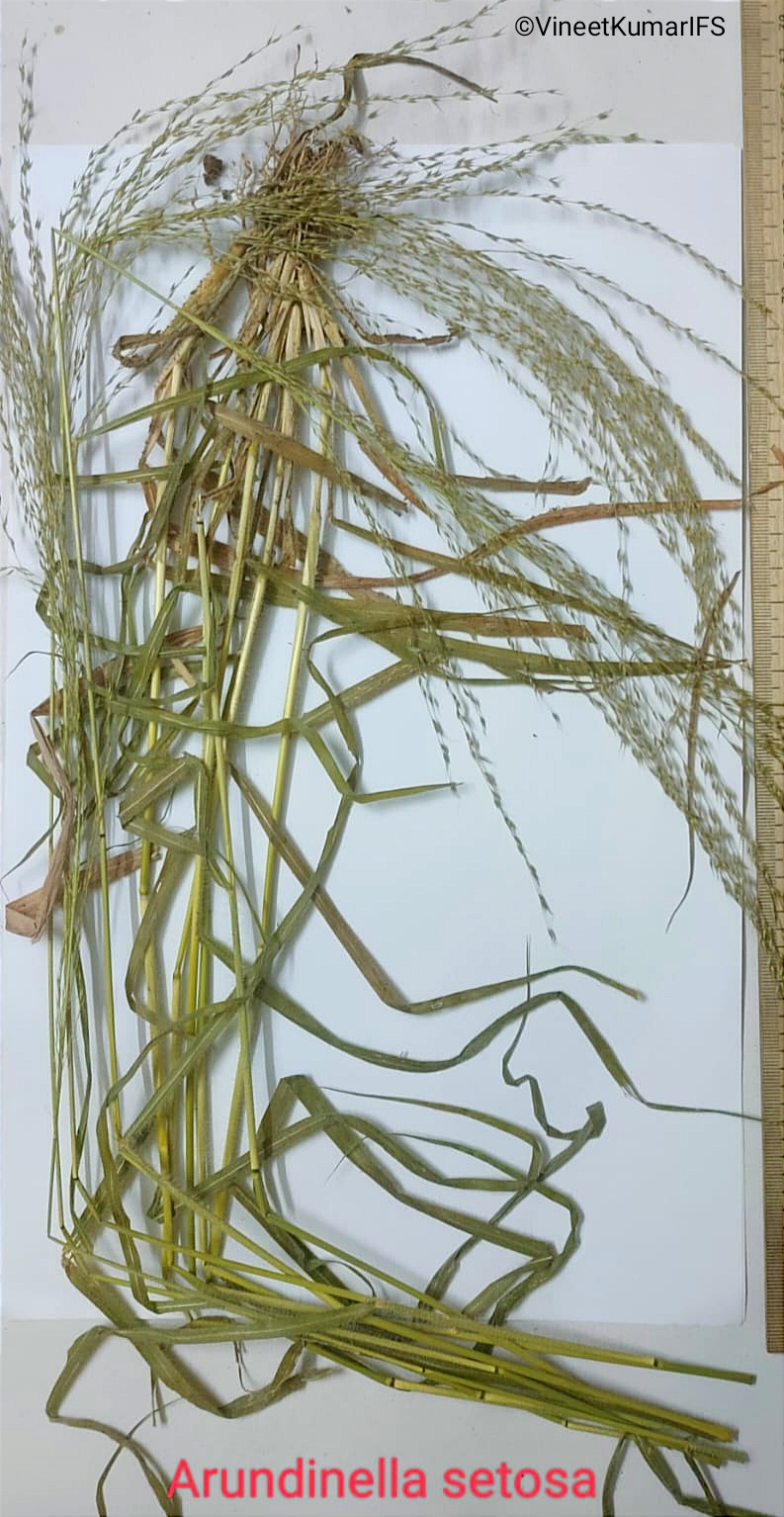
| 6. | Arundinella setosa | A medium sized grass found in large numbers on sheet rock below leopard base camp Nandyal NSTR Nallamala forests. |
| 7. | Axonopus compressus | carpet grass found on moist shady areas and also grown in lawns at EEC Mahanandi, Pacherla Ecotourism and many other forests base camps. |
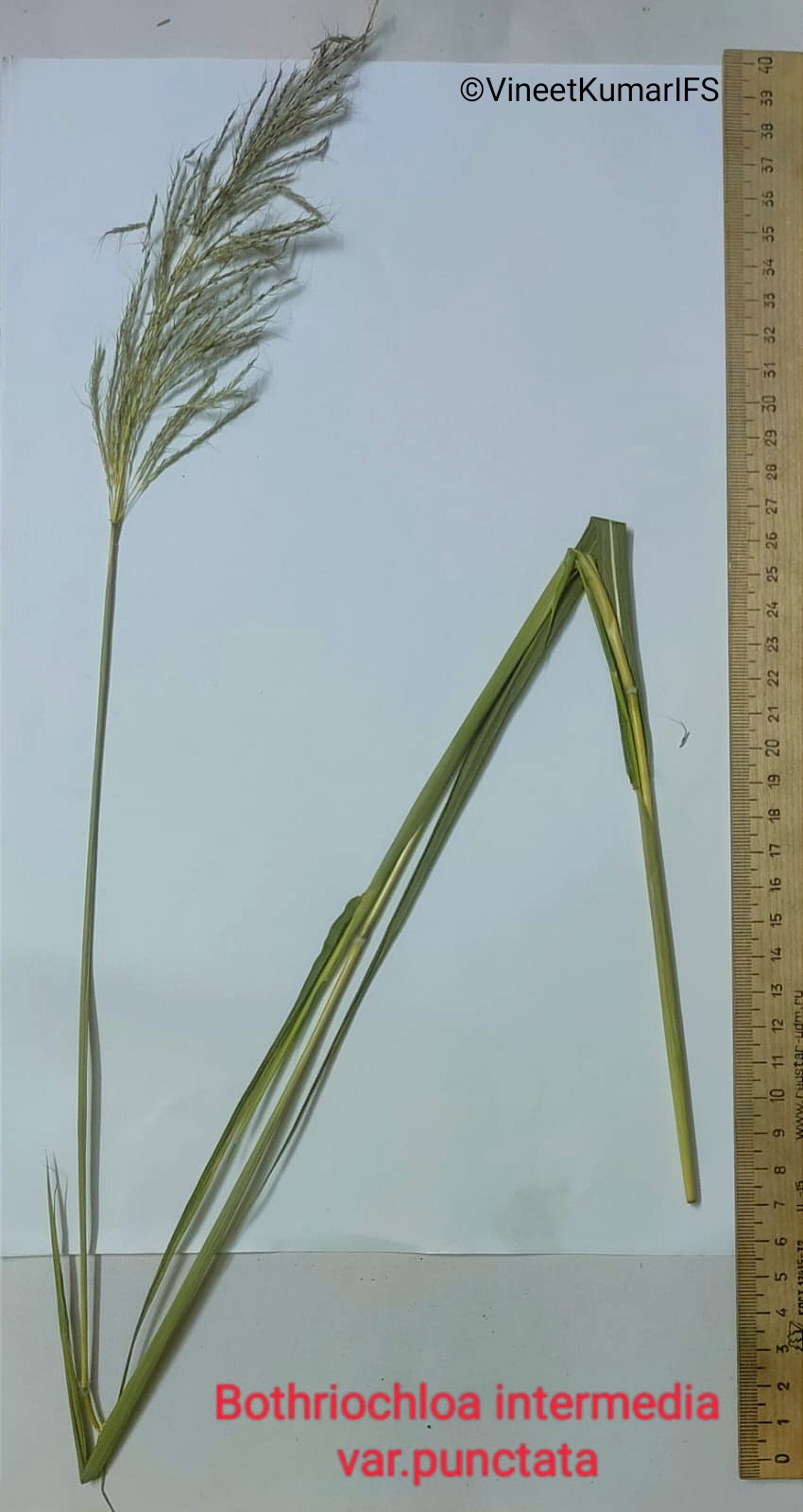
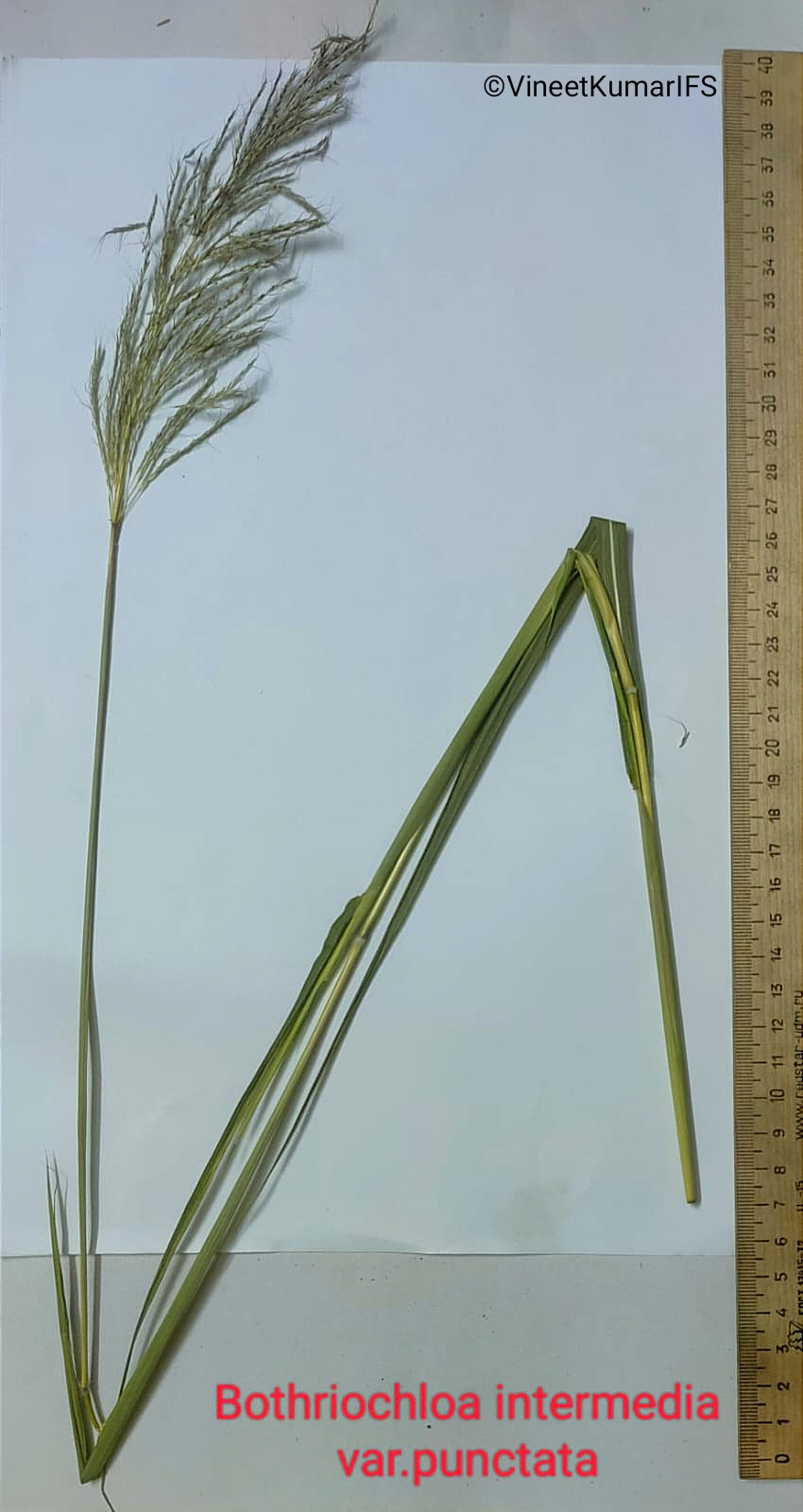
| 8. | Bothriochloa intermedia var. punctata | A robust grass with several racemes racemosely arranged on a rachis; common on roadsides around GBM. |
| 9. | Bothriochloa pertusa | A small grass with digitately arranged racemes with hairs on them; sessile spikelet with a circular pit; common on roadsides and base camp sites. |
| 10. | Brachiaria distachya | A dwarf grass with two alternately arranged racemes with spikelets arranged on one side of rachis. |
| 11. | Brachiaria setigera | A small grass withleaves with cordate base, several racemes alternately arranged and having a few white bristles on the rachis. |
| 12. | Chionachne koenigii | A tall grass with hispid hairy leaf sheaths and male and female spikelets on racemes subtended by spathes. Female seen as an oval white bead and male spikelets above it. |
| 13. | Chloris dolichostachya | A medium sized grass found in shady regions at GBM. Inflorescence having usually 4 long digitate racemes which on bending will give a beautiful awned ring like pattern. Racemes sometimes 1 to 6 usually imperfect or broken. |
| 14. | Chloris virgata | A small grass on roadsides along village roads with several white congested digitate racemes. |
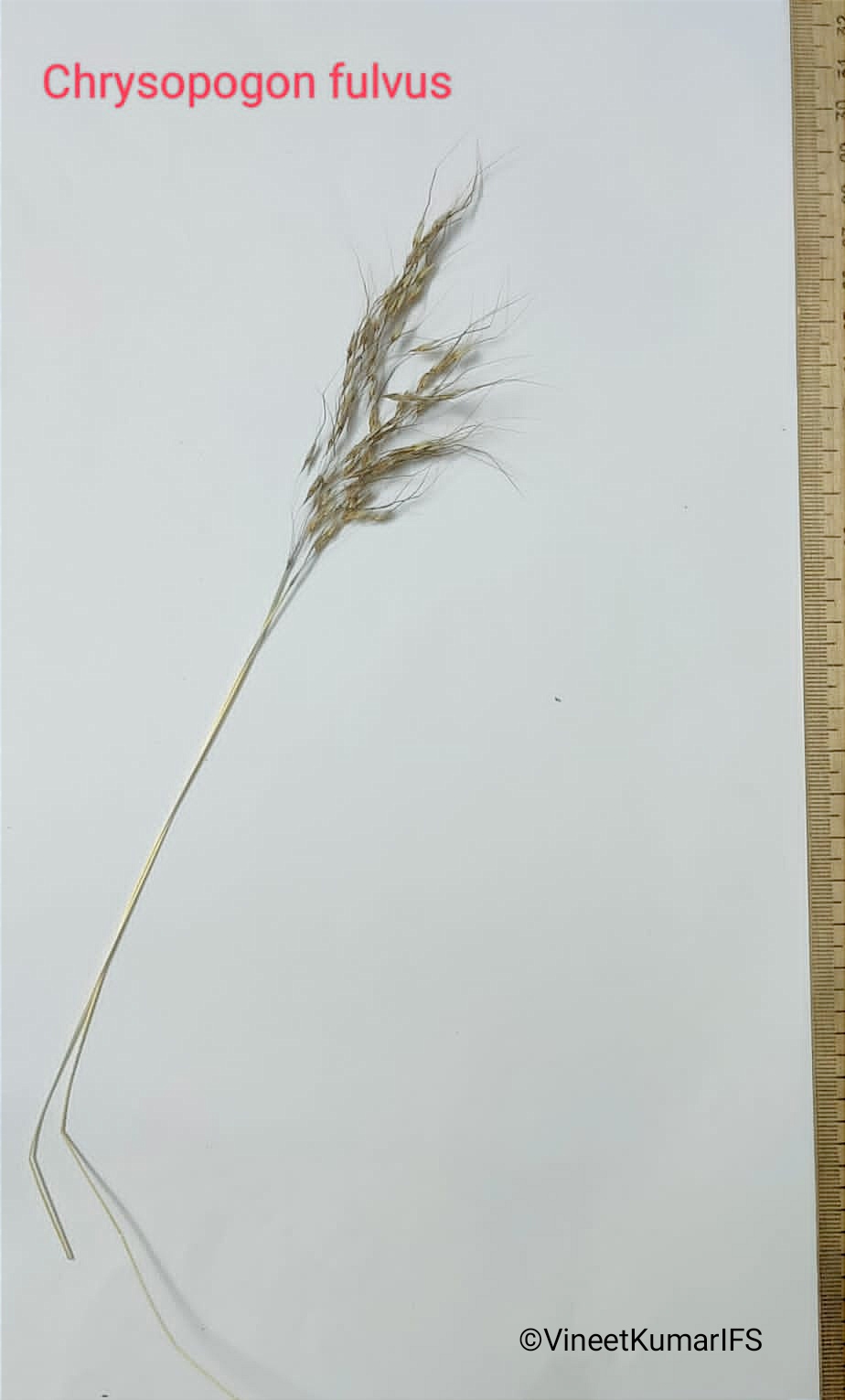
| 15. | Chrysopogon fulvus | A medium sized grass with beautiful panicle with golden spikelets – spikelets in threes (one sessile flanked by two pedicelled) at the tip of verticillate branches. Found in drier localities in GBM and is the major grass at Rollapadu GIB sanctuary. |
| 16. | Cymbopogon caesius | A tall grass with clumps of linear aromatic leaves at the base and long flowering stalks with hairy racemes – (group of twin racemes subtended by spathe), combination of leaf sheath (green) covering half of the yellow internode gives an alternate green-yellow pattern to the stems from a distance. Whole plant is glaucous (bluish white tinge). Found all over drier areas of Nallamala forests and on roadsides of highways and village roads. |
| 17. | Cymbopogon martinii | A tall grass with leaf bases cordate. Leaves aromatic. Commercially called Palmarosa. Found in patches at Pacherla grasslands. |
| 18. | Cynodon arcuatus | A dwarf grass with trailing stolons and lanceolate green leaves having 4-6 flexuous arcuate digitate racemes. |
| 19. | Cynodon dactylon | A prostrate spreading dwarf grass with linear leaves and racemes having 4 stiff racemes. Commonly called Doob ghas. दुब घास |
| 20. | Cyrtococcum trigonum | A dwarf mat forming grass growing in shady regions. Found on culverts across streams near GBM. |
| 21. | Dactyloctenium aegyptium | A small grass with long leaves and inflorescence with four stiff digitate racemes having multifloret spikelets. Common on waste places and urban areas. |
| 22. | Digitaria ciliaris | A small grass with ciliate leaves and inflorescence having 3-6 digitate racemes having spikelets arranged in pairs on a winged rachis. Common on roadsides and urban areas. |
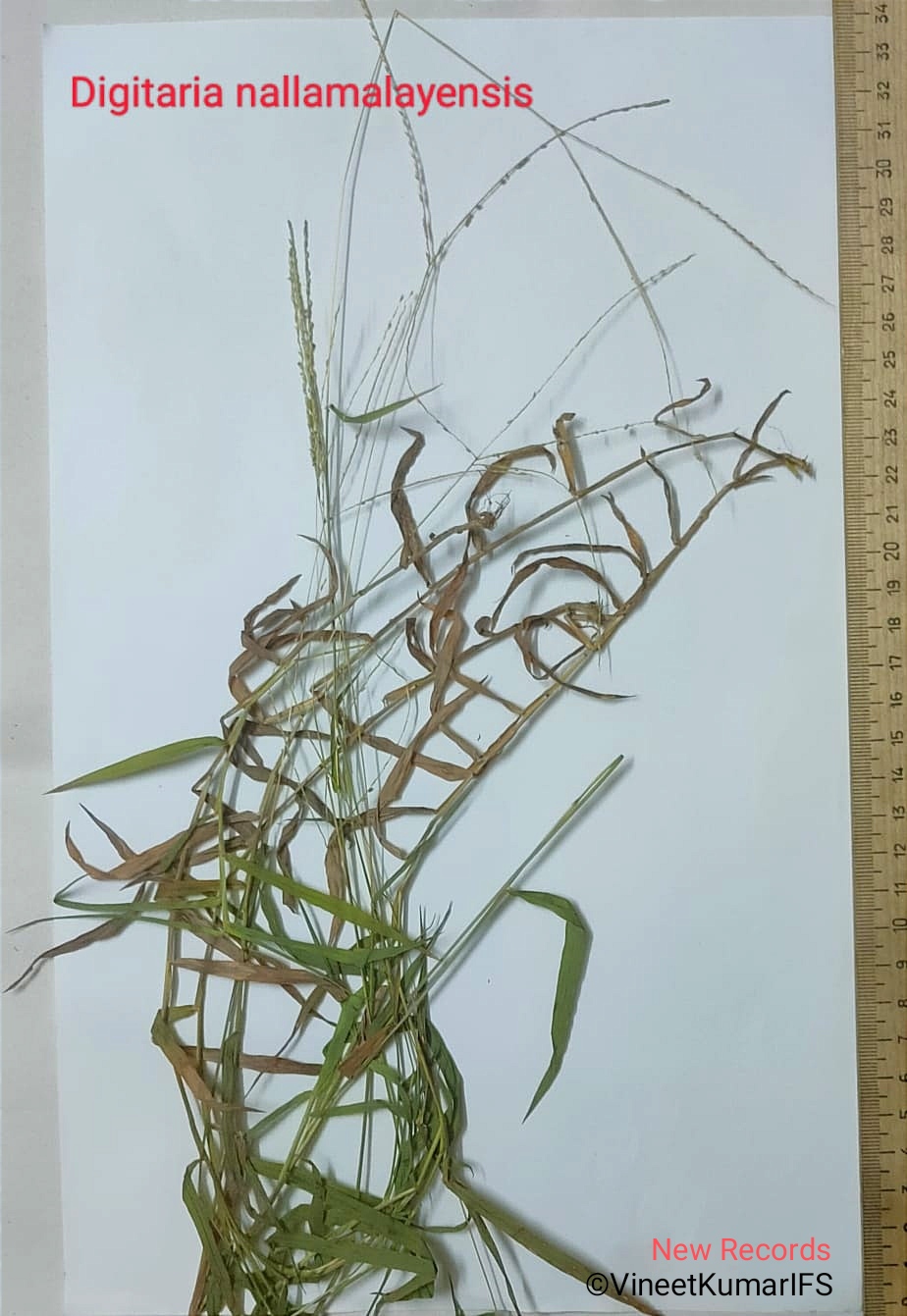
| 23. | Digitaria nallamalayensis* | A dwarf trailing grass with 2-3 digitate racemes with very small closely arranged hairy spikelets. Probably new to science – seen growing on roadside rocky slope on return from GBM to Leopard base camp. |
| 24. | Digitaria setigera | A small grass with long leaves with several digitate racemes on winged rachis having scattered bristles; common in shady areas. |
| 25. | Eleusine indica Wild ragi | A small grass with compressed leaf sheaths and inflorescence with 1 to several long digitate racemes having rows of multifloret spikelets on one side of rachis; found on roadsides and urban areas. |
| 26. | Eragrostiella bifaria | A small grass with narrow leaves and a long single spike like raceme bearing several long multifloret spikelets. Found on rocky patches. |
| 27. | Eragrostis japonica | A small grass with semi prostrate stems bearing small panicles with interrupted group of racemes bearing small multifloret spikelets; found in moister places. |
| 28. | Eragrostis tenella | A small annual grass with a small spreading delicate panicle bearing small multifloret spikelets on ends of branchlets. Hairs present on mouth of leaf sheath and panicle branch junctions. Common everywhere. |
| 29. | Eragrostis tenuifolia | A perennial grass with narrow long leaves and inflorescence consisting of a stiff panicle with long multifloret spikelets on pedicels having a glandular patch. Common on roadsides around GBM. |
| 30. | Eragrostis unioloides | A small grass with showy panicle having broad ovate multifloret spikelets which are in combination of white and purplish. Common along dry streams and road sides. |
| 31. | Eremopogon foveolatus | A medium sized grass having thin stems and inflorescence consisting of single racemes having spikelets with a circular pit on them. Common grass at Rollapadu bird sanctuary. |
| 32. | Eriochloa procera | A medium sized grass with green leaves and beautiful spreading panicle with spikelets subtended by a circular ring like callus below; found on moist areas near streams and ponds; found on way back from leopard base camp to Nandyal. |
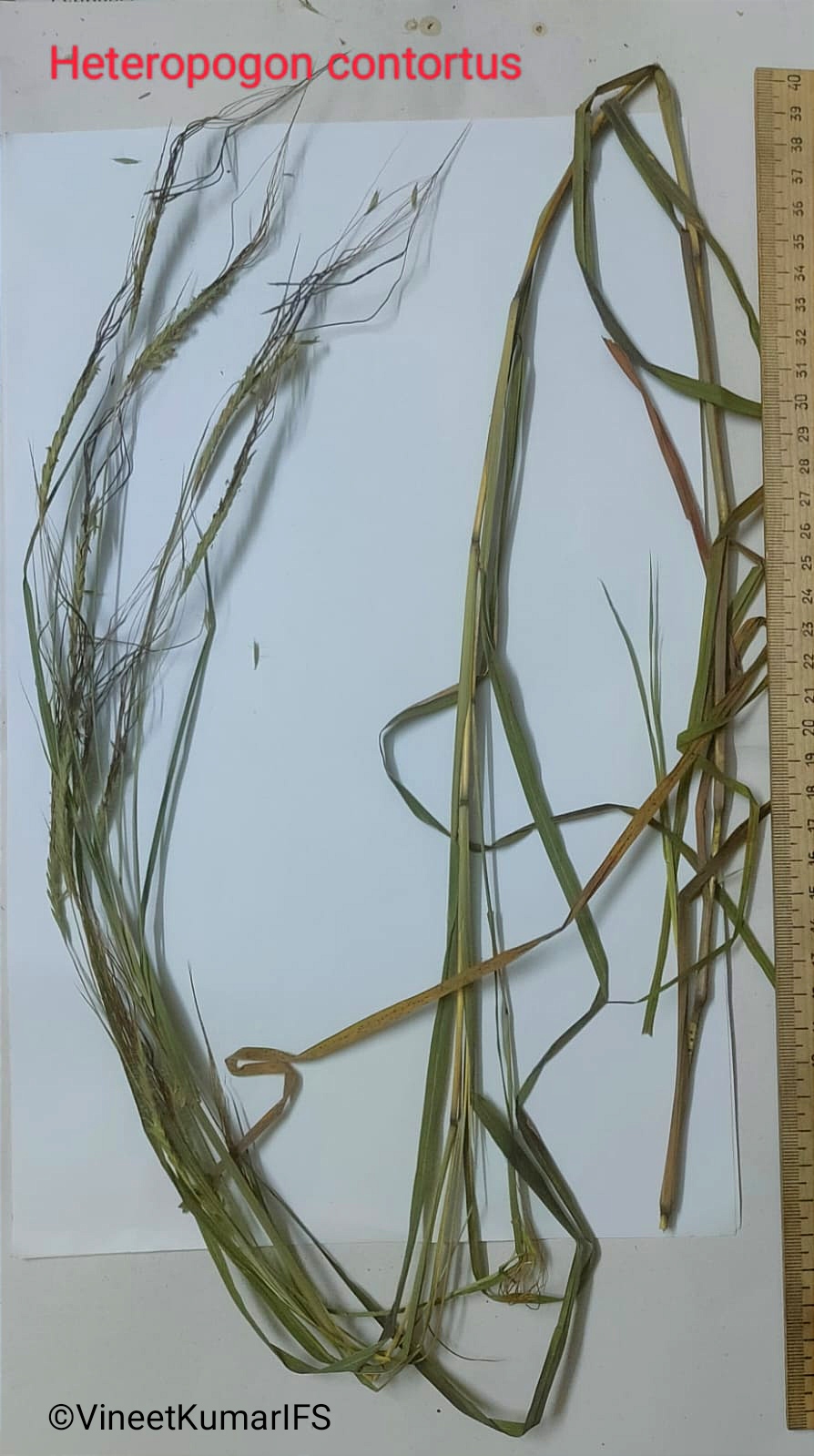
| 33. | Heteropogon contortus | A medium to tall grass with long hairy leaves and inflorescence consisting of single racemes bearing twisted overlapping spikelets with long black awns. The spikelets have tubercle based hairs all over, but some plants have glabrous spikelets and some plants have a glaucous shine. On way to GBM, these are very tall grasses, but at GBM, these are smaller and short grass at Rollapadu bird sanctuary depending on the soil and rock beneath. |
| 34. | Imperata cylindrica | A medium sized grass with spreading rhizomes and long leaves with sharp tip; inforescence a cottony cylindrical white panicle; seen in forest areas affected by fire and also in some lawns and roadsides. |
| 35. | Ischaemum indicum | A small grass with long leaves and long peduncles bearing inflorescence consisting of two divergent racemes; found along a stream at GBM. |
| 36. | Iseilema anthephoroides | A prostrate grass having several groups of spikelets subtended by spathes; found at Rollapadu bird sanctuary. |
| 37. | Oplismenus burmanii | A mat forming grass with ovate/elliptic leaves with undulate margins and bearing inflorescence with alternate racemes bearing soft awns; found in moist shady areas at Pacherla. |
| 38. | Oplismenus compositus | A spreading grass with larger ovate/elliptic leaves with undulate margins and bearing inflorescence with alternate racemes bearing stiff awns; found in moist shady areas at GBM. |
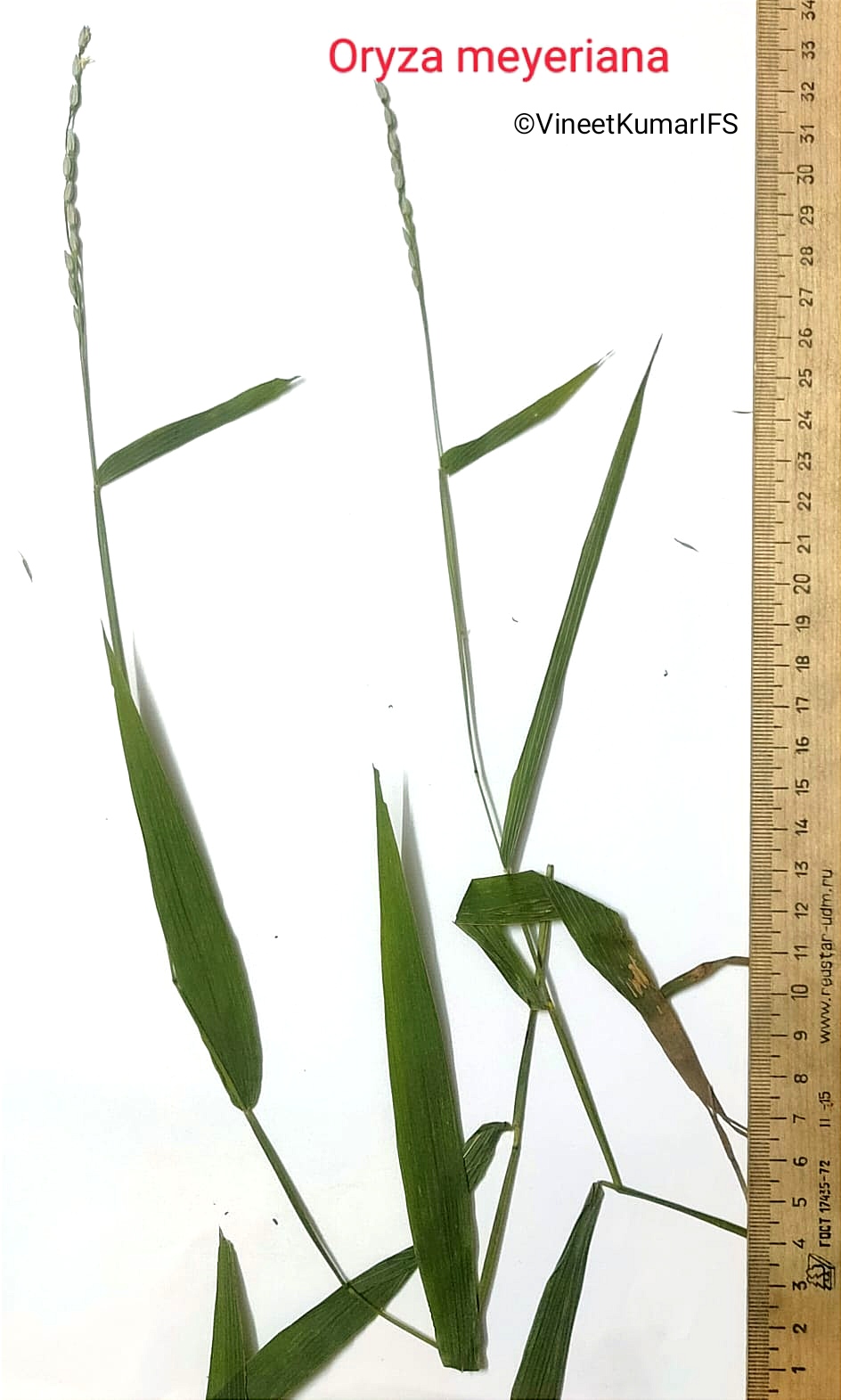
| 39. | Oryza meyeriana | A perennial grass with several stalks coming from rhizomes; inflorescene a spike like raceme bearing paddy-like deciduous spikelets; found under dense shade near high bank of streams. Ligule is a very short membrane. |
| 40. | Oryza officinalis | A fast spreading grass with very open and wide panicle bearing several deciduous paddy-like spikelets; found on stream floor and stagnant pools under dense shade. Ligule short pointed membrane. |
| 41. | Oryza sativa | Cultivated rice often found as escape; spikelets are not deciduous and the ligules are very long and pointed |
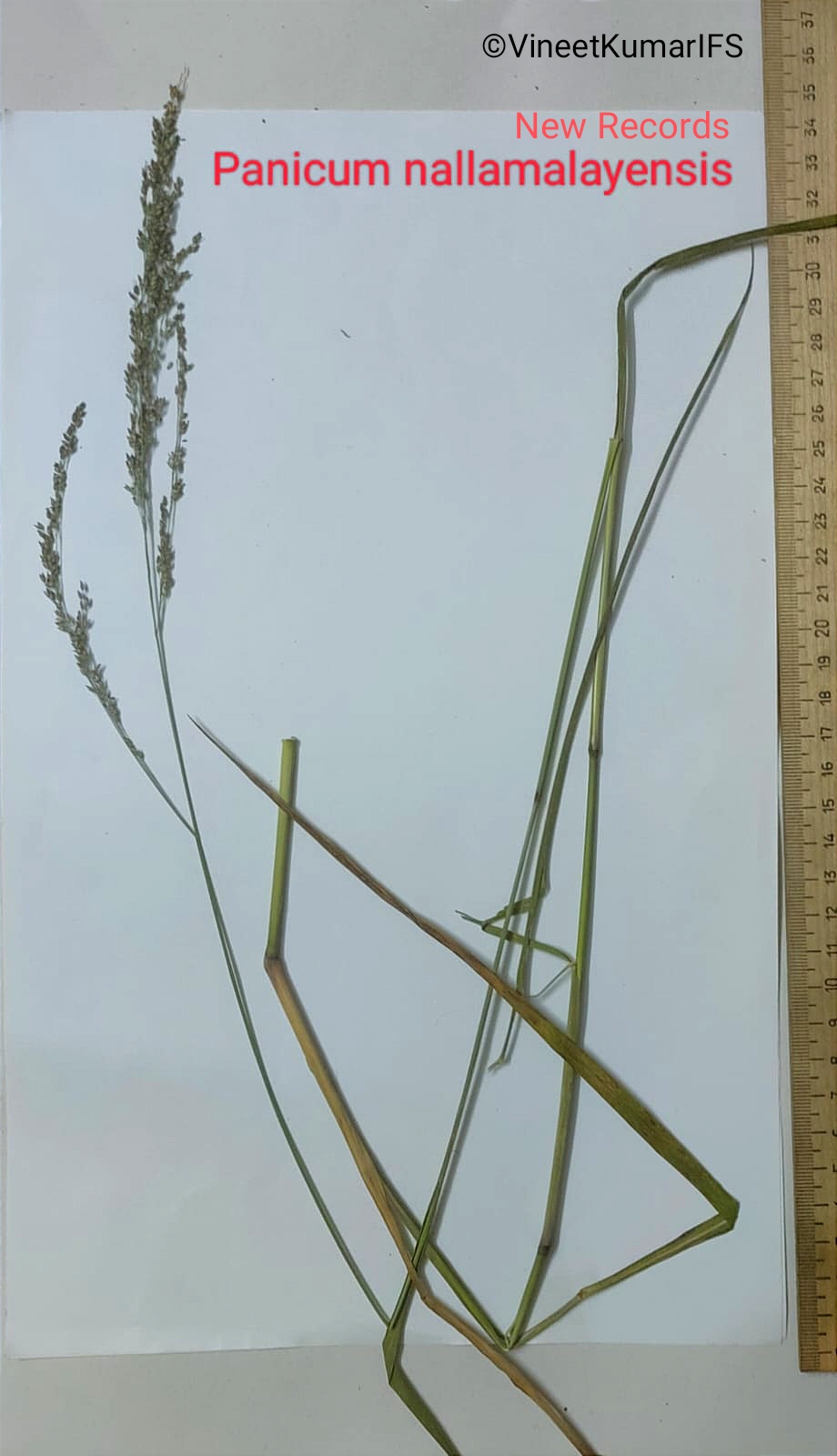
| 42. | Panicum nallamalayensis* | A geniculately ascending grass found on stream courses; found at stream crossing near leopard base camp; inflorescence paniculate with branches bearing contracted branchlets having dense spikelets with cuspidate lower glume – probably new to science |
| 43. | Panicum notatum | A tall perennial forest grass with widely spaced leaves with cordate base and inflorescence very widely spreading with small spikelets at the ends of the branchlets. |
| 44. | Paspalidium flavidum | A small grass with inflorescence having a single long peduncle bearing spaced racemes oriented parallel to the peduncle; found in moist localities and road sides. |
| 45. | Paspalidium geminatum | A semi-aquatic trailing grass found on swampy areas and lakeshores having single long peduncle bearing overlapping racemes oriented parallel to the peduncle; found along a swampy lake on way to Mahanandi from Nandyal, AP. |
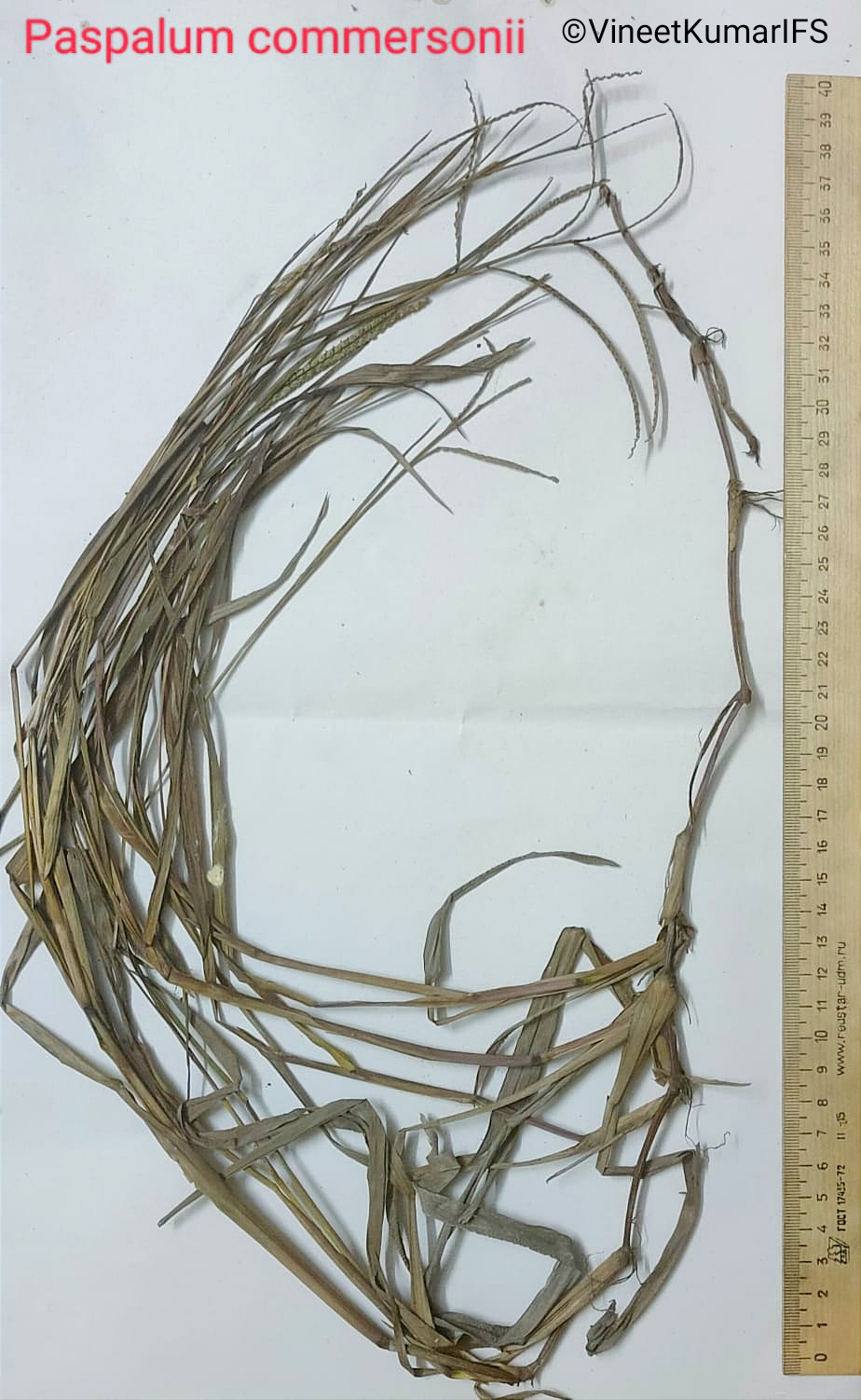
| 46. | Paspalum commersonii | A trailing geniculate grass rooting at nodes with long green leaves and inflorescence consisting of 2-5 curved racemes with obovate-orbicular spikelets on one side of a flat rachis; found around GBM temple. |
| 47. | Pennisetum americanum | Cultivated Bajra escaped to the wild – found on road sides. |
| 48. | Pennisetum pedicellatum | Very common grass characterised by a mixture of purple and white cottony spicate inflorescence and stilt rooted stems. Some plants bear pink to purple inflorescence turning pale on maturity while some plants bear white to cream inflorescence while some plants show intermediate characters. |
| 49. | Pennisetum polystachyon | A tall grass with long showy golden coloured spicate inflorescence; found on forest fringes near Mahanandi area. |
| 50. | Pennisetum purpureum | The commonly grown fodder grass, introduced in forest areas and also escaped into the wild – tall stems and stiffer leaves and cylindrical inflorescence usually yellow in colour. |
| 51. | Perotis indica | A dwarf grass with small leaves with cordate base and inflorescence consisting of a bottle-brush like spicate raceme bearing long thin awned spikelets; found on sandy soils and barren roadsides. |
| 52. | Rottboellia cochinchinensis | Tall grass having itching stiff hairs on leaf sheaths especially towards bottom and inflorescence consisting of a single raceme with tailed tip and spikelets easily breaking off the rachis in a transverse manner. |
| 53. | Saccharum officinarum | Cultivated sugarcane sometimes escaping into the wild, rural and urban areas. |
| 54. | Saccharum spontaneum | A tall widely spreading grass having long stolons and rhizomes; seen along rivercourses and sandy shores; bearing long white-silvery hairy inflorescence having several simple racemes arranged on a long rachis; very common along stream banks and riverine areas. |
| 55. | Sacciolepis indica | A dwarf grass with a small cylindrical inflorescence having saccate (one side convex and other side concave) spikelets; found in open, moist places. |
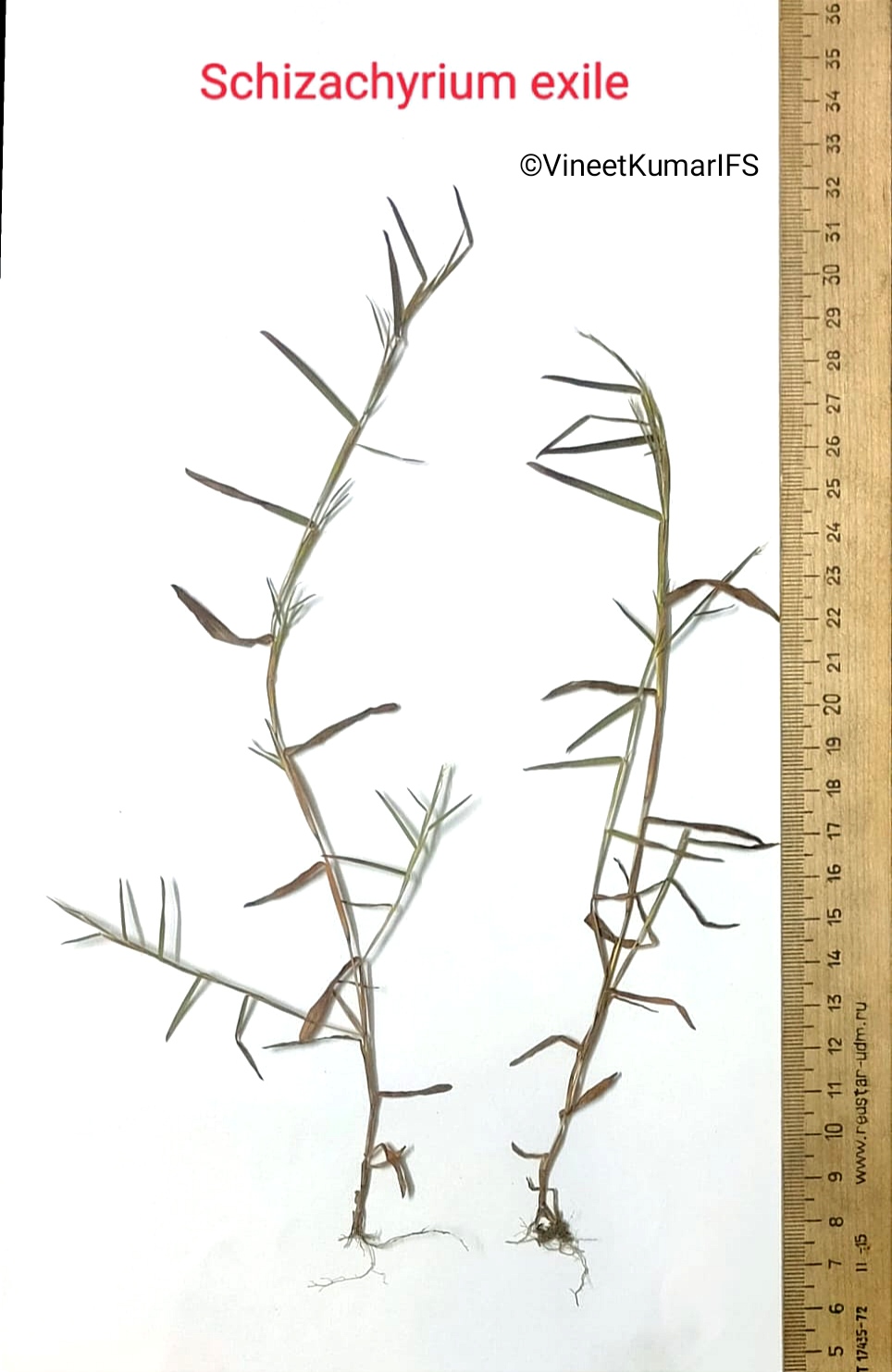
| 56. | Schizachyrium exile | A very dwarf grass with small pointed leaves and delicate spikelets not easily visible; found on rocky areas and dry road sides at GBM. |
| 57. | Sehima ischaemoides | A medium sized grass with single long curved raceme bearing long awned spikelets having curved and pointed tips; long awns usually visible only when the racemes is bent or dried. Racemes are curved and usually perpendicular or oriented at an acute angle to the stem. |
| 58. | Setaria pumila | A dwarf grass with cylindrical spicate racemes with deciduous spikelets subtended by several bristles which are permanent and does not fall off along with the spikelets. |
| 59. | Setaria verticillata | A medium sized grass with sticky cylindrical spicate racemes with several bristles having reverse oriented barbs making it stick to surfaces; very common along road sides and urban areas and also found at GBM. |
| 60. | Sorghum halepense | A tall, wild sorghum, introduced as fodder but escaped into wild as a weed. Have glaucous stems, long leaves with strong white midrib and inflorescence a wide spreading panicle bearing several shining spikelets; found at leopard base camp towards stream bund. |
| 61. | Sorghum vulgare | cultivated sorghum, often found as escape to the wild. |
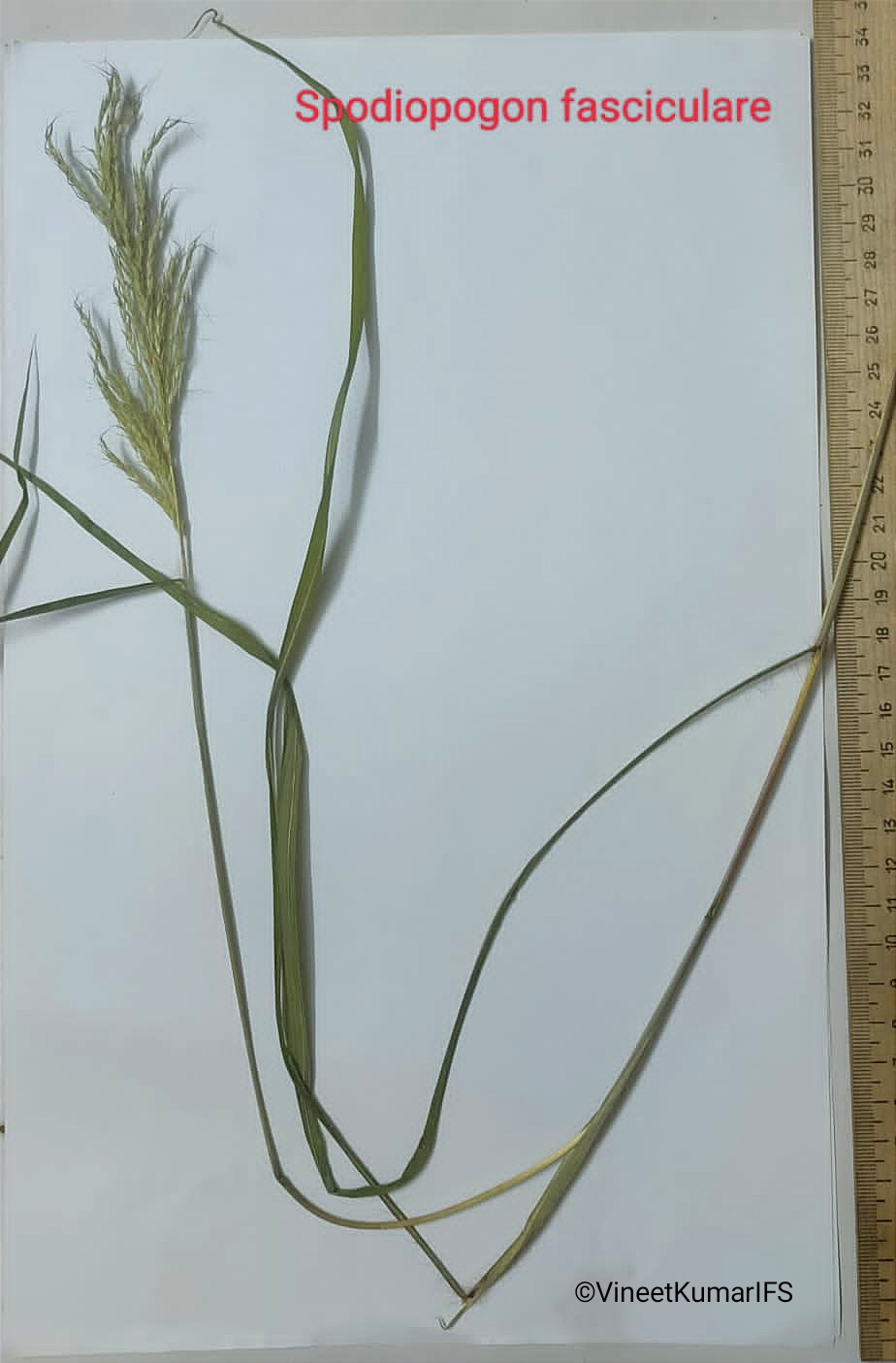
| 62. | Spodiopogon fasciculare | A medium sized grass with stilt roots and trailing on forest fringes bearing long peduncle having spaced branches bearing densely arranged shining spikelets; leaves are narrowed towards the base. Old name is Pseudosorghum fasciulare. |
| 63. | Sporobolus diander | A small grass with long linear leaves and inflorescence consisting of panicle with spirally arranged alternate branches bearing small densely arranged roundish spikelets with seeds falling off easily; florets have only 2 stamens; found in urban areas and roadsides. |
| 64. | Sporobolus wallichii | A perennial grass with long linear leaves and inflorescence consisting of large wide spreading panicle bearing small roundish spikelets with seeds falling off easily; florets have 3 stamens; found all along road sides, hill sides of GBM. |
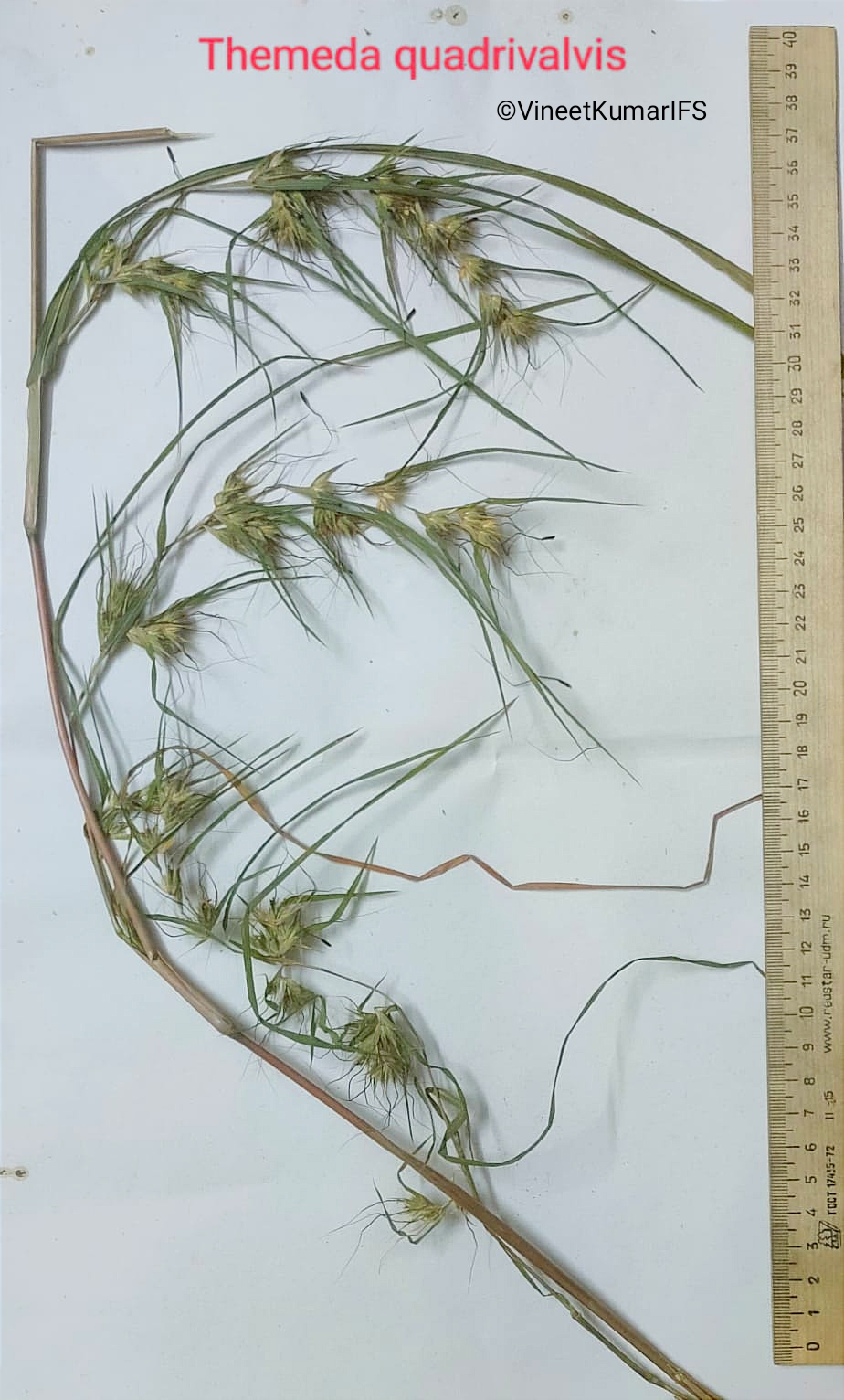
| 65. | Themeda quadrivalvis | A tall grass having long linear leaves and inflorescene consisting of several awned spikelets subtended by spathes. |
| 66. | Themeda triandra | A tall grass having long linear leaves and inflorescence consisting of a few long black awned spikelets (usually three awns in a group) subtended by spathes. |
| 67. | Zea mays | Cultivated maize often escaping to the wild |
| 68. | Zoysia tenuifolia | Lawn grass at EEC Mahanandi having small linear stiff leaves with pointed tips. |
New Records and Observations of Grasses species in Nallamala forests
*Panicum nallamalayensis- A geniculately ascending grass found on stream courses; found at stream crossing near leopard base camp; inflorescence paniculate with branches bearing contracted branchlets having dense spikelets with cuspidate lower glume – probably new to science.
*Digitaria nallamalayensis- A dwarf trailing grass with 2-3 digitate racemes with very small closely arranged hairy spikelets. Probably new to science – seen growing on roadside rocky slope on return from GBM to Leopard base camp.

By:Shri Vineet Kumar IFS and Rupak
(Helping hand Sri Manoj Chandran)
Disclaimer: Content and photos of records and observations belong to the authors. No ay kind of permission is given to anyone.
Copyrights ©VineetKumarIFS Rupak2023. AllRightsReserved.


 Rupak🌱